Azerbaijan, Russia, and Iran are accelerating efforts to expand the North–South International Transport Corridor (INSTC), aiming to turn it into one of Eurasia’s most strategic trade routes connecting the Baltic and Barents Seas with the Persian Gulf.
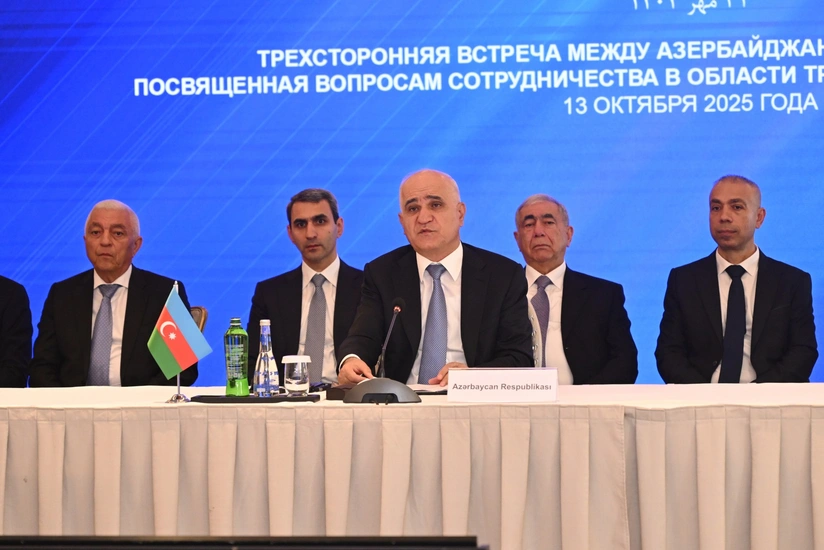
At a trilateral meeting held in Baku, the delegations – led by Azerbaijani Deputy Prime Minister Shahin Mustafayev, Russian Deputy Prime Minister Aleksei Overchuk, and Iran’s Minister of Roads and Urban Development Farzaneh Sadegh – discussed transportation, customs, and energy cooperation as part of a broader plan to deepen economic integration across the region.
Freight Turnover Up 8.3% in Nine Months
Speaking at the session, Mustafayev announced that cargo volume along the North–South Corridor rose by 8.3% in the first nine months of 2025 compared to the same period last year.
“Azerbaijan, as the only country sharing land borders with both Iran and Russia, plays a strategic role on the western section of the North–South Corridor,” Mustafayev said. “This geographic advantage enables us to strengthen regional connectivity and make this route one of the key arteries of Eurasian trade.”
According to the deputy prime minister, a guaranteed annual cargo volume of at least 5 million tons will be transported through Azerbaijan starting in 2028, under an intergovernmental agreement signed with Russia in late 2024. Following infrastructure modernization, the target volume could later increase to 15 million tons per year.
Infrastructure Projects Near Completion
Mustafayev confirmed that construction of the Aghbend–Kelala bridge over the Araz River — a critical part of the so-called Araz Corridor – will be completed by the end of this year, with border and customs facilities ready by early 2026.
He also noted that new highways and railways on the Goradiz–Aghbend route are expected to be completed next year. “This new branch of the East–West and North–South corridors will connect the Persian Gulf with the Black Sea,” he said.
Iran Calls for Full Digitalization of Cargo Documentation
Iran’s Minister Farzaneh Sadegh proposed a complete digital transformation of cargo documentation among the three countries to improve efficiency and prevent delays.
“The North–South Corridor is a vital link for all three nations,” she said. “By 2030, freight volume is expected to reach 15 million tons annually, but this requires streamlined border crossings and unified electronic documentation systems.”
Sadegh added that work is progressing on the Rasht–Astara railway, being constructed jointly with Russia, as well as on a 107-kilometer Julfa–Kelala highway that will connect Iran with Azerbaijan’s Nakhchivan region.
Russia Highlights Logistics Growth and Customs Reforms
Russian Deputy Prime Minister Aleksei Overchuk stated that 176,000 transport vehicles have already carried goods along the corridor in 2025, underscoring its growing economic role.
He emphasized that Russia and Azerbaijan have increased cargo throughput capacity at border checkpoints fivefold, from 400 to 1,900 trucks per day, with modernization work continuing at the Novo-Filya, Tagirkent-Kazmalyar, and Yarag-Kazmalyar crossings. Once completed, total capacity will reach 3,000 trucks per day.
Overchuk also reported that bilateral trade between Russia and Iran grew by 33%, while Russia’s imports from Azerbaijan rose by 9.5% to $742.4 million in the first seven months of this year.
Commitment to Regional Partnership
In his closing remarks, Mustafayev reaffirmed Azerbaijan’s commitment to good-neighborly relations and equal partnership with both Iran and Russia.
“The regional consultative mechanism 3+3, initiated by President Ilham Aliyev, complements our bilateral formats and strengthens security, stability, and economic growth across the region,” he said.
Delegations are scheduled to inspect key infrastructure sites along the North–South Corridor on October 13 to assess ongoing construction and modernization efforts.